Since we tested (updated October 2026)
We filmed our testing in 2022 (the video went up in November 2022). We haven’t re-tested our three picks since, but we re-checked all three on October 8, 2026. Here’s what’s changed:
- All three are still sold. None has been discontinued.
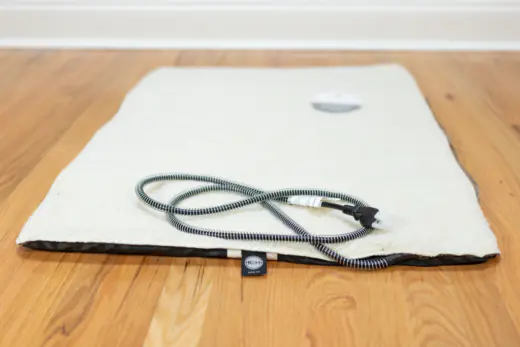
- K&H Lectro-Soft: our old button went to K&H’s Deluxe Lectro-Soft, a different bed with a bolster that was sold out in every size. It now goes to the regular Lectro-Soft we tested, which is on sale for $59.98–$99.98 depending on size (we listed it at $82 before).
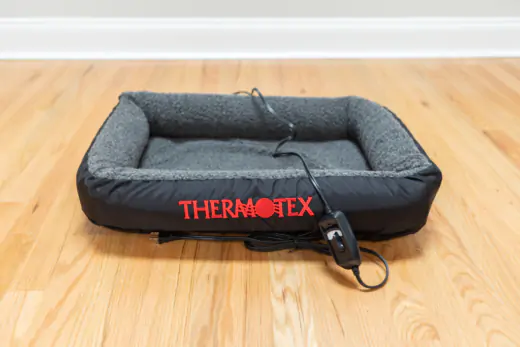
- Thermotex: now $189 (we listed $169), on a new page on Thermotex’s site.
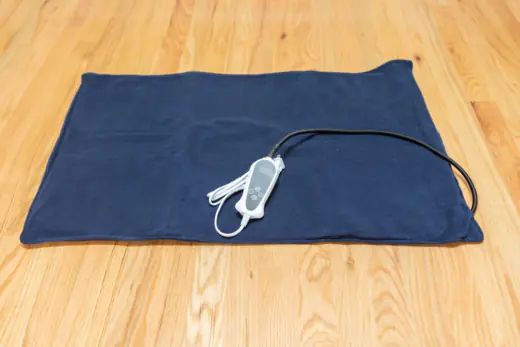
- RIOGOO: its website is gone, and the pad is only sold through big online marketplaces now. We don’t link to those, so there’s no buy button for it.
Other options worth knowing about (NOT tested by us): we haven’t tested these, so they’re not in our rankings.
Owner feedback
We searched Reddit, pet forums, YouTube comments and the makers’ sites for owner comments that name our three picks (checked October 8–9, 2026; we don’t use marketplace reviews). Most of the useful discussion is from cat owners and people who care for outdoor cats, since they use the same K&H pads, so we’ve noted where a comment is about cats or about a different model. These are paraphrased; follow the links for the full posts.
K&H Lectro-Soft (our top pick)
- The bad: newer pads feel thinner. In an r/Feral_Cats thread on K&H pads (November 2024), one caretaker who replaced an old Lectro-Soft found the new version “so disappointing,” with a thinner pad that left an awkward drop next to the shelter’s foam insert. Another said a new K&H soft mat was much thinner than their old one and didn’t heat as well.
- The good: cats used it. In the same thread, a caretaker running a mix of K&H pads said their outdoor cats consistently used one of their Lectro-Soft pads (alongside a larger rigid pad). They also passed on K&H’s advice to use only K&H’s own covers on its outdoor pads, so the heat isn’t blocked.
- Recommended for all-day use. In an r/BuyItForLife thread about heating pads for cats (December 2025), one commenter said to pick a pad that’s safety listed for continuous pet use, with a removable fleece cover, and named K&H’s Lectro-Soft and Thermo-Kitty pads as ones that usually fit the bill.
Other K&H heated beds and pads (different models, mostly cats)
- Long-lasting: in the same r/BuyItForLife thread, one owner said two K&H heated cat beds bought in 2009 and 2012 are still working and stay plugged in all year. They keep a folded towel on top, partly because their cats got too warm without it. Another has four K&H heated pads that have stayed plugged in for five or six years and still work.
- Not warm enough for one owner: the person who started that thread went with K&H, and a later reply (January 2026) said the pad was “lukewarm at best.”
- Indoor pads aren’t built for outdoors: in an r/Feral_Cats thread (January 2026), one caretaker wouldn’t use K&H’s indoor pads outside because they’re labeled indoor only. Another does, but noted they’re lighter duty and lack the metal-wrapped cord the outdoor pads have, and plugs everything outdoors into a GFCI outlet.
- A heated shelter isn’t always enough: a caretaker in Western New York (January 2025) said their heated K&H cat shelters weren’t enough on their own for heavy snow and cold, and that fleece pad covers got damp from snow and started to freeze. They suggested adding a well-insulated shelter too.
Thermotex
- A few years with no problems: in the r/BuyItForLife thread (December 2025), the owner of a small Chihuahua said they’ve used a Thermotex on low for a few years with no issues, and it still works well. (They didn’t say which Thermotex model.)
- A Chihuahua owner on YouTube: under a Bob & Brad Crew video about Thermotex infrared heat for cats and dogs with arthritis (YouTube), a viewer said their little Chihuahua “loves his” and thanked the hosts for the tip to keep it on the low setting. (The comment is from around 2023 and doesn’t name the model.)
- A human Thermotex pad used on a dog (older post, 2013): a blogger whose dog had IVDD and arthritis bought Thermotex’s Platinum pad, the version made for people, after the dog’s rehab clinic used one at the end of his laser therapy sessions (Musespeak, August 2013). The dog used it two or three times a day for about 30 minutes and moved around more afterward, though he got fidgety near the 30-minute mark. Their main complaint was the price: it was one of the most expensive options they’d found. This is not the pet bed, and the blogger notes its instructions say not to use it while sleeping.
- What we couldn’t find: independent complaints about the Thermotex pet bed. Thermotex’s product page has no customer reviews, and the other owner stories we found were published by Thermotex itself, so we left them out.
RIOGOO
- We didn’t find any recent Reddit comments about the RIOGOO pad.
Are heated dog beds safe?
Heated dog beds and pads are generally safe when you buy one that’s built for pets and use it the way the maker says. Here’s what we look for and what the makers of our three picks tell owners:
- Buy a pet product that’s safety listed as a whole. K&H points out that its beds are MET listed as a complete product, not just made with listed parts. Avoid using a human heating pad or electric blanket for your dog unless the maker says it’s safe for pets.
- Look for a thermostat, a timer, or both. The K&H’s thermostat warms it to your dog’s body temperature (102°F) when your dog lies on it. The RIOGOO has a temperature sensor and an auto-off timer.
- Protect the cord. A steel-wrapped cord (K&H) or chew-resistant cord (RIOGOO) helps, but no cord is chew proof. The Thermotex cord isn’t wrapped at all.
- No chewers. Every heated bed has wires inside. If your dog chews or tears up beds, skip electric beds and use a self-warming bed instead.
- Give your dog a way to move off the heat. K&H says to always leave your pet room to choose whether to lie on the pad or off it, and to talk to your vet first for young puppies, pets recovering from surgery or illness, or any dog that can’t get off the pad on its own.
- Follow the instructions. Don’t fold a heated bed or pad, and don’t plug it into an extension cord (K&H’s MET-listed beds carry that warning). RIOGOO’s instructions say to keep the pad flat, never use it wet, and switch it off when you leave. Outdoor beds like the Lectro-Soft are made for sheltered spots, out of direct rain or snow.
Best heated dog bed for outdoors
Of our three picks, only the K&H Lectro-Soft is made for outdoor use. It’s built for a covered porch, garage, barn, kennel or dog house, with a water-resistant soft vinyl shell and a steel-wrapped cord. K&H says to set it on a hard, flat surface out of direct rain or snow, not to fold it to fit, and not to use an extension cord, so measure the floor of the dog house and check where the outlet is before you buy. If your outdoor dog chews, K&H’s rigid Lectro-Kennel pad (not tested by us) is the version it recommends instead. The RIOGOO and Thermotex are indoor-only.
How to Choose A Heated Pet Bed
Consider how and where your dog likes to sleep. Is he destructive or likes to chew? Most dog beds are not appropriate for power chewers, particularly beds and pads that are heated with an electrical element and need to be plugged into the wall. Even heated pads with chew-resistant cords, like the RIOGOO we tested, may not be right for your dog if he chews. The bed itself could be damaged and the heating elements exposed. Most electric heated dog beds have safety features to reduce the risk of electrocution, but if your dog likes to ruffle, dig or root around in his bed or chew, you should probably consider a self-warming bed. Self-warming beds such as the Best Friends by Sheri OrthoComfort Deep Dish Cuddler (sold out on Best Friends by Sheri’s site when we checked on Oct 8, 2026) are an excellent alternative and contain thermal materials that reflect the heat of your dog back to him. Also, consider if the bed is washable or not.
Be sure the bed is big enough to accommodate your dog in all his favorite sleep positions. If you have dogs that like to curl up together, consider getting a bed big enough for both to have a little wiggle room. Measure your dog from his head to the bottom of his back leg when extended. This should be the depth of the bed, and the width should be a few inches bigger than his length (snout to base of tail).
Heated bed, heating pad, self-warming bed or blanket? Which type is right for your dog
| Type |
How it warms |
Best for |
Watch out for |
| Electric heated bed |
Built-in heater and thermostat |
Seniors, outdoor shelters |
Cords and chewers |
| Heating pad or mat |
Flat pad in or under a bed |
Adding heat to a bed you own |
Keep it flat and covered |
| Self-warming bed |
Reflects your dog’s own heat |
Chewers, no outlet, travel |
Some crinkle |
| Microwavable warmer |
Heated in the microwave |
No cord, short warmth |
Follow heating times |
We’ve narrowed our reviews into several categories for heated dog beds:
Heating Pad Style: An insert meant to be used with an existing dog bed, blankets, or furniture.
- Usually a thin, waterproof pad with a removable cover.
- Goes under a blanket or inside your dog’s own bed, so it’s only as comfortable as what’s on top of it.
- Often the cheapest way to add heat, and easy to move from room to room.
Pillow or Mat Style Bed: A mat-shaped bed with no sides or edges.
- These beds can easily flatten out over time if cheaply made.
- Not all beds will have a washable outer layer, but most do. Most of these beds have an inner layer of foam or filling that cannot be washed and may harbor allergens or dirt. They will need to be replaced often.
Bolster Style Bed: Similar to the pillow bed, but with raised edges or a nest-style.
- Most dogs love the security of a bolster and will snuggle up against the walls.
- Not all beds will have a washable outer layer, but most do. The inside of these beds can harbor allergens and dirt and cannot be washed.
- Most comfortable and soothing for most dogs.
Additionally, there are two other categories used for these reviews:
Self-warming and Electric. Electric dog beds plug into an outlet. Look for steel reinforced cords. Self-warming beds typically use Mylar, a PET film that reflects and radiates the dog’s heat back to them as they lay on the bed. Sometimes beds containing Mylar will crinkle, and while most dogs don’t care, some are spooked by it. Pay close attention to your dog’s reaction to the sound to gauge if he will mind it.
For senior dogs and arthritis: gentle, steady warmth can help a stiff dog get comfortable. The Thermotex is made for this, but only for dogs up to 24 lbs. For a bigger dog, a larger heated bed with an orthopedic foam base (like the Lectro-Soft) or a heated insert inside an orthopedic bed you already own are good options. Talk to your vet about pain that’s new or getting worse; a heated bed is a comfort aid, not a treatment.
For large and small dogs: the Lectro-Soft comes in three sizes, up to 25″ x 36″ (Large). The RIOGOO goes up to 32″ x 20″, and the Thermotex bed fits pets up to 24 lbs only. For a big dog, measure first and remember that a pad only warms the area it covers.
Heated dog bed FAQ
Are heated dog beds safe?
Yes, if you choose one made and safety listed for pets, follow the maker’s instructions and don’t use one with a dog that chews. Look for a thermostat or auto-off timer and a protected cord, and make sure your dog can move off the heat. See our safety section above.
Can I leave a heated dog bed on all the time?
It depends on the bed, so check the maker’s instructions. K&H says the Lectro-Soft is designed to stay plugged in 24/7 (unplug it if you go away on a long trip). RIOGOO’s instructions say to switch its pad off when you leave, and its timer turns it off automatically. Never leave a heated bed plugged in with a dog that chews.
Do heated dog beds help dogs with arthritis?
Many owners find warmth helps a stiff, older dog get comfortable, and that’s what the Thermotex infrared bed is made for (for dogs up to 24 lbs). It’s a comfort aid, not a treatment, so check with your vet about joint pain.
What’s the best heated dog bed for outdoors?
Of our three picks, only the K&H Lectro-Soft is made for outdoor use, in a covered area like a porch, garage, barn or dog house. For a dog that chews, K&H recommends its rigid Lectro-Kennel pad instead (we haven’t tested it).
Is there a cordless or wireless heated dog bed?
Not among our three picks; all three plug in. For warmth without a cord, use a self-warming bed, which reflects your dog’s own body heat, or a microwavable warmer like K&H’s, which K&H says stays warm for up to 12 hours (we haven’t tested either).
What’s the difference between a heated and a self-warming dog bed?
A heated bed plugs in and uses a heating element. A self-warming bed has no electricity; a reflective layer bounces your dog’s own body heat back to them. Self-warming beds are safer for chewers but won’t get as warm.
What is the warmest dog bed for winter?
A heated bed that plugs in will feel warmer than any unheated bed. K&H says its heated beds warm to 102°F, a dog’s normal body temperature, when your dog lies on them. If your dog can’t use an electric bed (for example, because he chews), a self-warming bed is the next best thing, and one with raised sides gives him something to curl up against.
How much electricity does a heated dog bed use?
Not much. The K&H Lectro-Soft uses 20 to 60 watts depending on size, and Thermotex says its 35-watt bed costs under 3 cents a day to run on low.